Work

A world war between classes, not countries

While powerful beneficiaries of war and military spending – major banks (as primary lenders to governments) and the military-security-industrial complex – thrive on war and international tensions, they nonetheless tend to prefer local, national, limited, or “manageable” wars to large scale regional or global wars that, in a cataclysmic fashion, could paralyze global markets altogether.

This goes some way to explain why in pursuit of regime change in Iraq and Libya, for example, the United States and its allies relied on direct military action/occupation; whereas in cases like Ukraine and Iran they have (so far) avoided direct military intervention and relied, instead, on “soft-power” tactics and color-coded revolutions.
Let’s Call The Whole Thing Off

It is astonishing that this pernicious web of lies has been spun largely unchallenged; that the construction of this vast edifice of fabrication has been permitted. Yet the powerful mythology surrounding benefits comes tumbling down with the slightest pressure; crumbles at the gentlest application of logic or rationality, shatters and splinters on exposure to mere facts.

“The dogs bark, but the caravan passes on.”

Only when Mark Carney, Christine Lagarde and Prince Charles start talking about the abolition of privately created debt-based money should we even begin to take them seriously. Of course such an affront to the obscenely wealthy would have seen even Prince Charles ejected from the Mansion House soiree.

Chaos, misery and mass suffering? It’s only a Tube strike

Of all the complaints you hear about the Underground, one that crops up very little is, “I wish there weren’t so many ticket offices”
Boris Johnson says the new system will be an improvement for passengers, because it will “shift staff from behind the windows to where they can be seen”. But the plans are to cut 950 ticket office staff, and put only 200 extra staff round the stations. So when he says he’s going to put them “where they can be seen”, maybe he means on the next series of Benefits Street.

Festival of Dangerous Ideas 2013: David Simon

There are two Americas. In one, bankers get golden parachutes, insider traders return to society as well-paid consultants, and influence is for sale. In the other, opportunity is scarce and forgiveness scarcer, jail awaits those caught possessing recreational drugs, and cries for help are ignored. Society preaches forgiveness for the rich and retribution for the poor. Entrenched inequality and its companion, poverty, are the dark side of the American dream for a citizenry united by name, but not by rules.

The Techtopus: How Silicon Valley’s most celebrated CEOs conspired to drive down 100,000 tech engineers’ wages

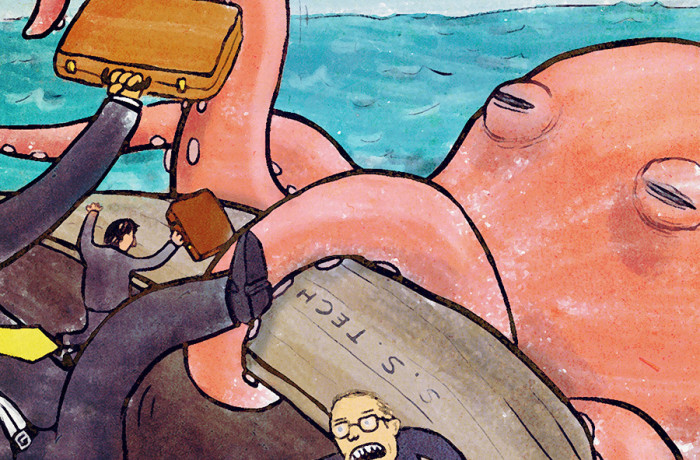
In early 2005, as demand for Silicon Valley engineers began booming, Apple’s Steve Jobs sealed a secret and illegal pact with Google’s Eric Schmidt to artificially push their workers wages lower by agreeing not to recruit each other’s employees, sharing wage scale information, and punishing violators. On February 27, 2005, Bill Campbell, a member of Apple’s board of directors and senior advisor to Google, emailed Jobs to confirm that Eric Schmidt “got directly involved and firmly stopped all efforts to recruit anyone from Apple.”

UK’s long-term youth unemployment hits record high

According to the statistics from the Labour Force Survey (LFS), the number of under-25s without a job for a year or more increased from 266,000 in 2012 to 282,000 in September 2013, The Daily Mirror reported on Saturday.

Last year’s figure is just under the 285,000 recorded in 1993, when John Major was British Prime Minister.

A Short History of Elite Responses To Political-Economic Crisis

The performance of the US economy from the mid-1970s to the present was no match for its relatively robust performance during what economists call the Golden Age – 1949 to 1973. This was in fact the longest period of sustained growth in US history, when most (white) working people had achieved a degree of material security unknown earlier and unattainable since. But from the late 1960s and through the 1970s economic malaise was increasingly in evidence, signaling worse to come: high rates of both inflation and unemployment -stagflation- was not supposed to be possible in a Keynesian (1) world, but there they were, and seemingly intractable.

UK firefighters to stage more strikes

“The Government must stop claiming they are negotiating when they have refused to talk for two months and insist on forcing through proposals that are unaffordable, unworkable and unfair,” said FBU General Secretary Matt Wrack.