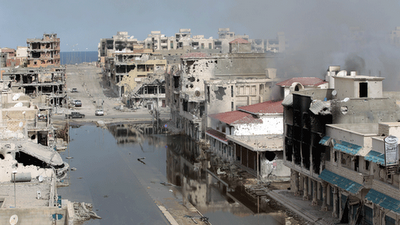
During the NATO bombardment, news from Libya dominated the front pages and was the first news item on every Western and Arabic television station. There was 24-hour coverage about the Libyan Liberation miracle and the great victory achieved by NATO and the revolutionaries. Nowadays it is very rare to find a Western reporter there and even more rare to read a decent report about Libya and what is really going on there.
Libya
Globalists Target 100% State Owned Central Bank of Libya
BSN Editor Note: In case you were wondering about the recent saber rattling and media hype for attacking Syria with Tomahawk cruise missiles, remember the real reason the west attacked Libya in 2011. The 144 tons of gold belonging to the people of Libya is currently sitting in a bank vault in the city of London – will this ever be returned we ask rhetorically?
“Lessons from Libya: How Not to Intervene”
The Conventional Wisdom Is Wrong. Libya’s 2011 uprising was never peaceful, but instead was armed and violent from the start. Muammar al-Qaddafi did not target civilians or resort to indiscriminate force. Although inspired by humanitarian impulse, NATO’s intervention did not aim mainly to protect civilians, but rather to overthrow Qaddafi’s regime, even at the expense of increasing the harm to Libyans.
Libya’s Destruction – Based On “Exceptionalism”, Lies And Propaganda
It is alarming that military intervention in internal conflicts in foreign countries has become commonplace for the United States. Is it in America’s long-term interest? I doubt it. Millions around the world increasingly see America not as a model of democracy but as relying solely on brute force, cobbling coalitions together under the slogan “you’re either with us or against us.”
Larry Summers and the Secret “End-Game” Memo
The Memo confirmed every conspiracy freak’s fantasy: that in the late 1990s, the top US Treasury officials secretly conspired with a small cabal of banker big-shots to rip apart financial regulation across the planet. When you see 26.3% unemployment in Spain, desperation and hunger in Greece, riots in Indonesia and Detroit in bankruptcy, go back to this End Game memo, the genesis of the blood and tears.
US Planned Syrian Civilian Catastrophe Since 2007
While the UN and nations across the West feign shock over the growing humanitarian catastrophe unfolding in and around Syria, the goal of a violent sectarian conflict and its predictable, catastrophic results along with calls to literally “bleed” Syria have been the underlying strategy of special interests in the United States, Israel, Saudi Arabia and their regional partners since at least 2007.
Libya and Its Contexts
Hysterical claims that Qadhafi was on the verge of carrying out a genocide rang out in the Western press. However, these had little basis. Forte quotes Alan J. Kuperman, noting that, “The best evidence that Khadafy did not plan genocide in Benghazi is that he did not perpetrate it in the other cities he had recaptured either fully or partially — including Zawiya, Misurata, and Ajdabiya.” During his 42 year rule, Qadhafi faced numerous coup attempts and armed revolts. Though he typically dealt with the alleged perpetrators in a brutal fashion, at no point did his regime behave in a genocidal manner.
Massacres That Matter – Part 2 – The Media Response On Egypt, Libya And Syria
Corporate media coverage of atrocities in Egypt, Libya and Syria has closely matched US-UK government interpretations and priorities.
While the US government has refused to describe what was very obviously a military coup in Egypt on July 3 as a coup, many media have also tended to shy away from the term, referring instead to the ‘ousting’ and ‘removal’ of the elected government.
In reporting atrocities in Libya and Syria, the BBC focuses heavily on the word ‘crime’, but described the mass murder in Egypt on August 14 as a ‘tragedy’. Killing in Syria is routinely described as a ‘massacre’, but in Egypt often as the less pejorative ‘crackdown’.
Massacres That Matter – ‘Responsibility To Protect’ In Egypt, Libya And Syria – Part 1
The ‘responsibility to protect’ (R2P), formulated at the 2005 UN World Summit, is based on the idea that state sovereignty is not a right but a responsibility. Where offending states fail to live up to this responsibility by inflicting genocide, ethnic cleansing and other crimes against humanity on their own people, the international community has a responsibility to act. Economic sanctions and the use of military force can thus be employed as ‘humanitarian intervention’.
John Perkins: Confessions of an Economic Hitman
As an Economic Hitman (EHM), John Perkins helped further American imperial interests in countries such as Ecuador, Panama, Indonesia and Saudi Arabia. As Chief Economist for the international consulting firm Chas. T. Main, he convinced underdeveloped countries to accept massive loans for infrastructure development and ensured that the projects were contracted to multinational corporations. The countries acquired enormous debt, and the US and international aid agencies were able to control their economies.
‘Limited But Persuasive’ Evidence – Syria, Sarin, Libya, Lies
By David Edwards Last month, a ComRes poll supported by Media Lens interviewed 2,021 British adults, asking: ‘How many Iraqis, both combatants and civilians, do you think have died as a consequence of the war that began in Iraq in 2003?’ An astonishing 44% of respondents estimated that less than 5,000 Iraqis had died since 2003. 59% believed that fewer […]
Libya: Race, Empire, and the Invention of Humanitarian Emergency
Based on Prof. Maximilian Forte latest book, “Slouching Towards Sirte: NATO’s War On Libya and Africa” (Baraka Books, Montreal, 2012), and nearly two years of extensive documentary research, this film places the 2011 US/NATO war in Libya in a more meaningful context than that of a war to “protect civilians” driven by the urgent need to “save Benghazi”. Instead it […]