Russia

Ukraine President Once Agent for U.S. State Department

The players and plans have been in place for years and it’s all paid off. The White House and their masters finally have their insider in place in charge of Ukraine. It’s worth listening to the assessment of former U.S. Ambassador to Ukraine John E. Herbst and his Deputy around the time they handled Poroshenko. The ambassador saw him as a “disgraced oligarch” and his deputy pointed out that “Poroshenko was tainted by credible corruption allegations.”

Spreading brand democracy around the world is a tough job. Somebody’s got to do it.

Dispatching B-2 Stealth Bombers to Europe Obama’s Attempt at Intimidating Russia

Less than 24 hours after Ukraine’s new president Petro Poroshenko announced his determination to retake Crimea from Russia, US Admiral Cecil Haney confirmed that the US Air Force had deployed two B-2 stealth bombers to Europe to conduct military exercises. The addition of the multipurpose B-2, which is capable of delivering nuclear weapons, is intended to send a message to Moscow that the United States is prepared to provide backup for Ukraine’s fledgling government and to protect its interests in Central Asia. News of the deployment was reported in the Russian media, but was excluded by all the western news outlets.

A world war between classes, not countries

While powerful beneficiaries of war and military spending – major banks (as primary lenders to governments) and the military-security-industrial complex – thrive on war and international tensions, they nonetheless tend to prefer local, national, limited, or “manageable” wars to large scale regional or global wars that, in a cataclysmic fashion, could paralyze global markets altogether.

This goes some way to explain why in pursuit of regime change in Iraq and Libya, for example, the United States and its allies relied on direct military action/occupation; whereas in cases like Ukraine and Iran they have (so far) avoided direct military intervention and relied, instead, on “soft-power” tactics and color-coded revolutions.

Washington’s Iron Curtain in Ukraine

U.S. Secretary of State John Kerry led the chorus of self-righteous indignation, accusing Russia of the sort of thing his own government is in the habit of doing. “You just don’t invade another country on phony pretext in order to assert your interests. This is an act of aggression that is completely trumped up in terms of its pretext”, Kerry pontificated. “It’s really 19th century behavior in the 21st century”. Instead of laughing at this hypocrisy, U.S. media, politicians and punditry zealously took up the theme of Putin’s unacceptable expansionist aggression. The Europeans followed with a weak, obedient echo.

An Empire Without a Military Strategy for a Military Strategy Without an Empire

President Obama has stated his strategic doctrine at West Point. In his speech, he reiterated the military omnipotence of the United States, while it is technically surpassed by both Russia and China. Unable to cope with Moscow, he glossed over the loss of the Crimea in silence and instead designated the only worthy enemy: the tactics of terrorism. While al-Qaeda camps are located in countries under occupation by NATO or NATO members, he announced a comprehensive program to combat them. Finally, he reiterated his support for the “Syrian opposition” and promised that he would not fail to bring them help… when he gets Congressional approval.

Premature US Victory-Dancing on Ukraine

The post-coup election of a pro-Western politician as president of Ukraine – and the escalating slaughter of lightly armed anti-coup rebels in the east – have created a celebratory mood in Official Washington, but the victory dance may be premature, says ex-CIA analyst Ray McGovern.

Just imagine… If Russia had toppled the Canadian government

There is no legal or moral basis for saying that the US and its allies should be able to do things, which if done by other countries, would be condemned as wrong and punished with the imposition of sanctions and/or military attack or invasion. International law and the principles of non-interference in other nations should apply equally to all: regardless of the country’s political system or form of government. The British government has no more right to interfere in the internal affairs of Syria than the Syrian government has to interfere in the internal affairs of Great Britain. The US has no more right to ‘regime change’ in countries bordering Russia, than Russia has to ‘regime change’ in countries bordering the US.

Putin vs. Comrade Wolf – Showdown in Ukraine

The Ukraine crisis has its roots in a policy that dates back nearly 20 years. The origins of the policy can be traced to a 1997 article in Foreign Policy magazine by Zbigniew Brzezinski, titled “A Geostrategy for Eurasia.” The article makes the case that the United States needs to forcefully establish itself in Central Asia in order to maintain its position as the world’s only superpower. While many readers may be familiar with Brzezinski’s thinking on these matters, they might not know what he has to say about Russia, which is particularly illuminating given that the recent uptick in violence has less to do with Ukraine than it does with Washington’s proxy-war on Russia.

Western Media Blackout on the Reality in Ukraine

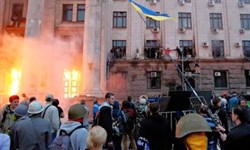
On 2 May 2014, there was a massacre that was initially reported as being of 116 anti-Kiev (or independence) demonstrators at the Trade Unions Building in Odessa. The latest reliable report (from an American, George Eliason, who lives in that area) indicates it to be instead “now counted at 272 people that were tortured, gassed …, bludgeoned, …, etc.,” above and beyond the numbers who had been incinerated there by the firebombing of the building. Western news-media unfortunately seem to be doing all they can to keep the public ignorant of what went on there, and of why.

The CIA Coordinates Nazis and Jihadists

The world is changing. Formerly, there was a capitalist right and a socialist left. Today, the world is dominated by the United States and the first question that arises is whether to serve or to resist them. As in World War II, we find all ideologies in each camp. For now, Washington coordinates the alliance between the Nazis and jihadists in Europe with the blessing of the anti-Putin Russians.

The birth of a Eurasian century

In his 1997 book The Grand Chessboard, Brzezinski argued that “the struggle for global primacy [would] continue to be played” on the Eurasian “chessboard,” of which “Ukraine was a geopolitical pivot.” “If Moscow regains control over Ukraine,” he wrote at the time, Russia would “automatically regain the wherewithal to become a powerful imperial state, spanning Europe and Asia.”

That remains most of the rationale behind the American imperial containment policy – from Russia’s European “near abroad” to the South China Sea. Still, with no endgame in sight, keep your eye on Russia pivoting to Asia, China pivoting across the world, and the BRICS hard at work trying to bring about the new Eurasian Century.