Globalisation

PR Mind Control: Even Better Than the Real Thing

Bernays’ vision of a smoothly functioning society had a dominant economic component. As described by Tim Adams of the London Observer, Bernays “thought that the safest way of maintaining democracy was to distract people from dangerous political thought by letting them think that their real choices were as consumers.”

A world war between classes, not countries

While powerful beneficiaries of war and military spending – major banks (as primary lenders to governments) and the military-security-industrial complex – thrive on war and international tensions, they nonetheless tend to prefer local, national, limited, or “manageable” wars to large scale regional or global wars that, in a cataclysmic fashion, could paralyze global markets altogether.

This goes some way to explain why in pursuit of regime change in Iraq and Libya, for example, the United States and its allies relied on direct military action/occupation; whereas in cases like Ukraine and Iran they have (so far) avoided direct military intervention and relied, instead, on “soft-power” tactics and color-coded revolutions.

Brave old (exceptionalist) world

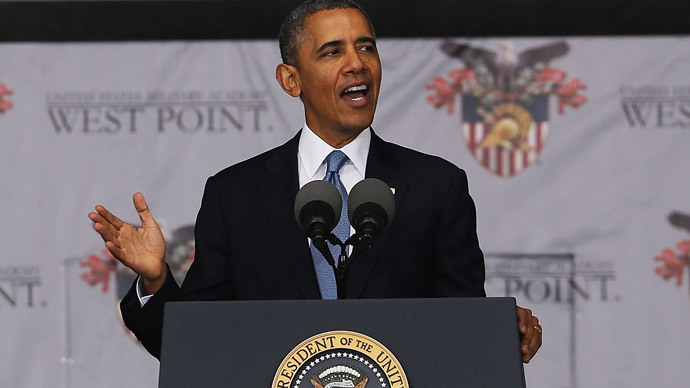
“I believe in American exceptionalism with every fiber of my being.” So there it is, straight from the lion’s mouth, as in US President Barack Obama.
The rest are details: deadly details, as in the US military remaining “at the core” of the exceptional worldview; the Pentagon reserving for itself “the power to launch unilateral attacks when America’s interests are directly threatened”; eight or nine proxy wars deployed in the immediate future with no end in sight; and the most startling admission – that the “fulcrum” of US foreign policy from now on will be to curb “aggression” by Russia and China.

10 Reasons to Love Uruguay’s President José Mujica

Mujica has refused to live at the Presidential Palace or have a motorcade. He lives in a one-bedroom house on his wife’s farm and drives a 1987 Volkswagen. “There have been years when I would have been happy just to have a mattress,” said Mujica, referring to his time in prison. He donates over 90 percent of his $12,000/month salary to charity so he makes the same as the average citizen in Uruguay. When called “the poorest president in the world,” Mujica says he is not poor. “A poor person is not someone who has little but one who needs infinitely more, and more and more. I don’t live in poverty, I live in simplicity. There’s very little that I need to live.”

85 Billionaires and the Better Half

The world’s 85 richest individuals possess as much wealth as the 3.5 billion souls who compose the poorer half of the world’s population, or so it was announced in a report by Oxfam International. The assertion sounds implausible to me. I think the 85 richest individuals, who together are worth many hundreds of billions of dollars, must have far more wealth than the poorest half of our global population.

Festival of Dangerous Ideas 2013: David Simon

There are two Americas. In one, bankers get golden parachutes, insider traders return to society as well-paid consultants, and influence is for sale. In the other, opportunity is scarce and forgiveness scarcer, jail awaits those caught possessing recreational drugs, and cries for help are ignored. Society preaches forgiveness for the rich and retribution for the poor. Entrenched inequality and its companion, poverty, are the dark side of the American dream for a citizenry united by name, but not by rules.

A Short History of Elite Responses To Political-Economic Crisis

The performance of the US economy from the mid-1970s to the present was no match for its relatively robust performance during what economists call the Golden Age – 1949 to 1973. This was in fact the longest period of sustained growth in US history, when most (white) working people had achieved a degree of material security unknown earlier and unattainable since. But from the late 1960s and through the 1970s economic malaise was increasingly in evidence, signaling worse to come: high rates of both inflation and unemployment -stagflation- was not supposed to be possible in a Keynesian (1) world, but there they were, and seemingly intractable.

Dissenting views on Nelson Mandela

Jean Bertrand Aristide once said that “it is better to be wrong with the people than right without them”. Post-Apartheid, it seems to me that Mandela made the worst possible choice – to be wrong without the people.

Corporate power and demand culture – rushing us towards oblivion

Corporations now call all the key shots, with the political class acting as gun-toting bodyguards. Despite the fig-leaf of parliamentary appearances, corporations have a malleable political elite in their boardroom-suited pockets. Political ‘participation’ is a wholesale pretence, the cartel of political parties just more corporate-type brands, And, while a corporate media helps keep the whole charade ideologically intact, corporate surveillance maintains a beady panoptic over the entire social and cultural landscape.

Why Aren’t We Rising up as Our Country is Sold Off & Our Govt Sells Out?

An apathetic mainstream media, an ambivalent political class and a broad populace who have become spectators rather than actors in their daily lives, have created the mistaken impression that Britain is taking its austerity hammering lying down. This could not be further from the truth. Many of the most disenfranchised groups in UK society are rising, rebellion is fomenting, and flames of dissidence are licking the powder keg of mainstream mood. So why doesn’t it feel like it?